
THE WHITING BLOCK EXPERIENCE
130 Years of Healing, Community & Curiosity
Scan, listen, and explore the story of 307 Main Street.
From F.T. Whiting’s 1894 apothecary to today’s Calyx Berkshire.
🎧 8 chapters • About 10 minutes • Free self-guided audio tour
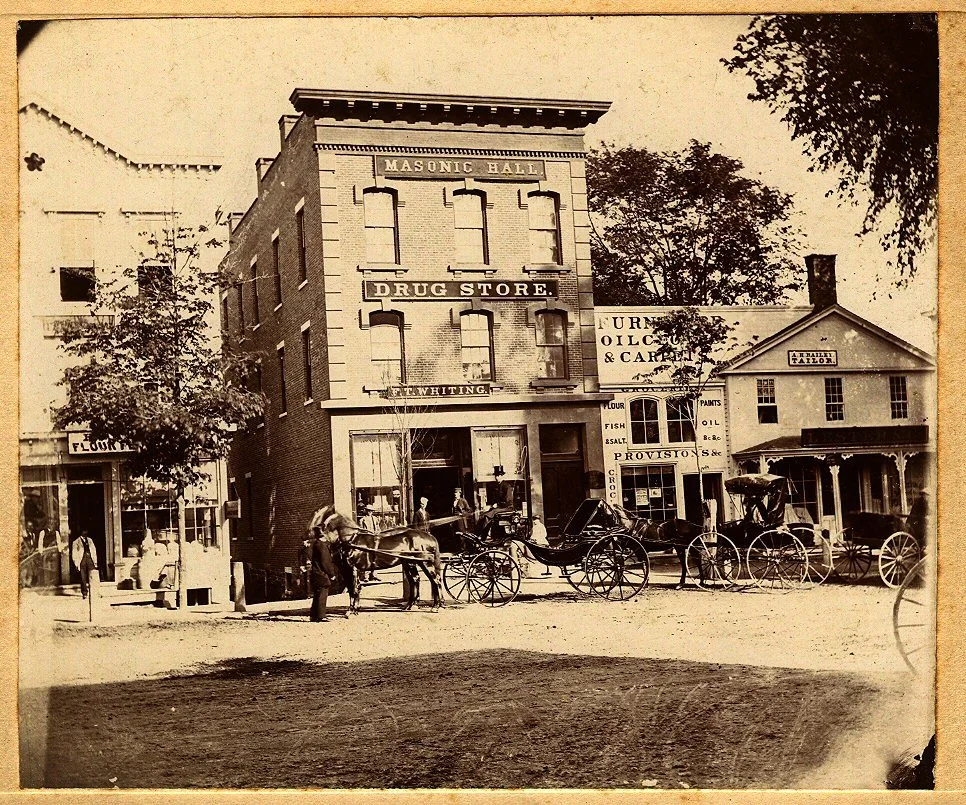
Welcome to the Whiting Block
CHAPTER TWO
The Apothecary
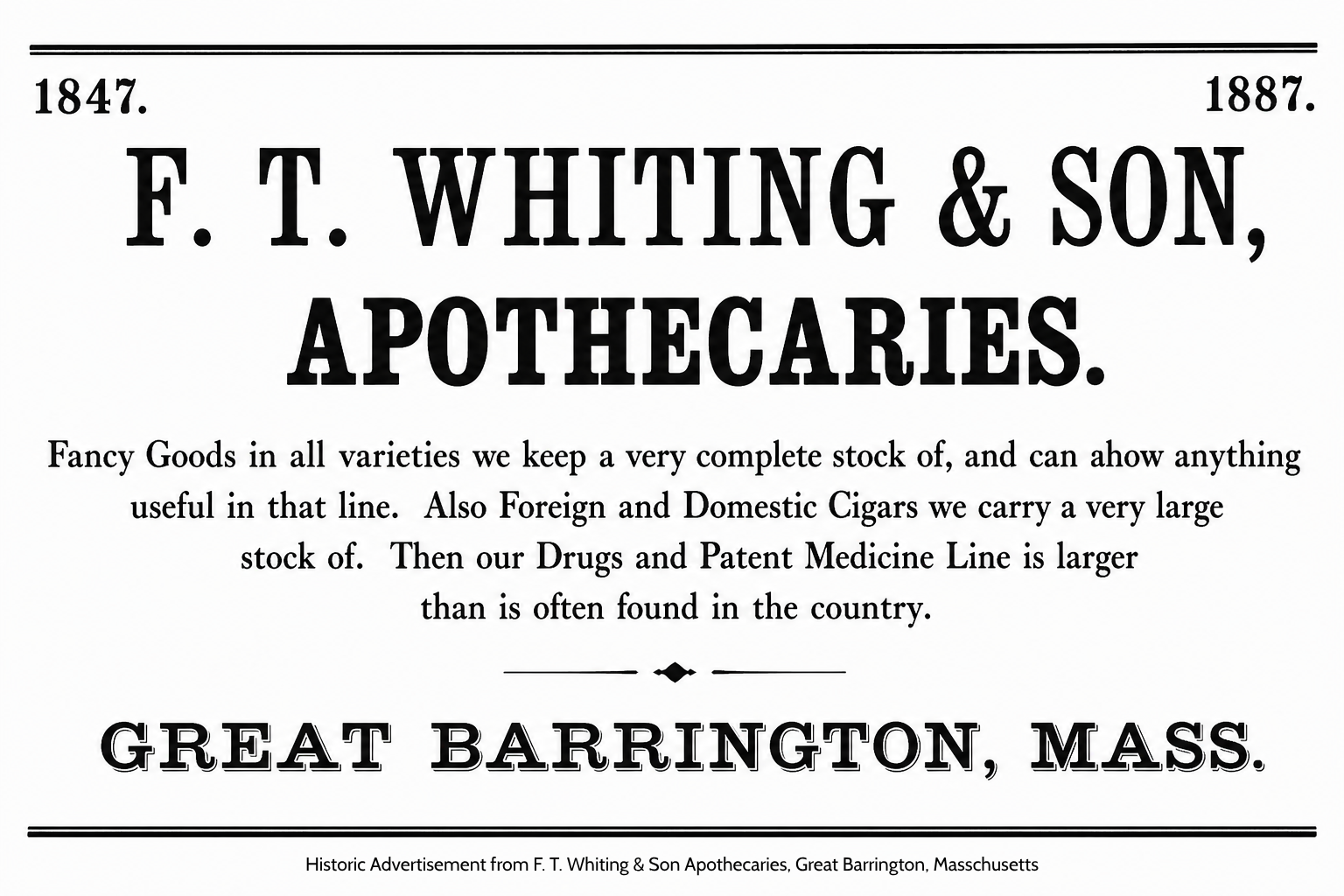
For generations, customers stepped into F.T. Whiting & Son seeking remedies, spices, soaps, perfumes, and household goods.
Pharmacists mixed medicines by hand and served as trusted advisors to the community.
By the 1880s, Frederick T. Whiting and his son, J. Frederick Whiting, operated one of Great Barrington's trusted apothecaries on Main Street.
Customers came seeking medicines, tonics, soaps, spices, perfumes, and household remedies. Prescriptions were prepared by hand, and pharmacists often knew generations of local families.
More than a store, the apothecary served as a place of healing, trust, and conversation.
From an 1887 advertisement:
"Our Drugs and Patent Medicine Line is larger than is often found in the country."
— F.T. Whiting & Son, Great Barrington
CHAPTER THREE
A Receipt from 1860
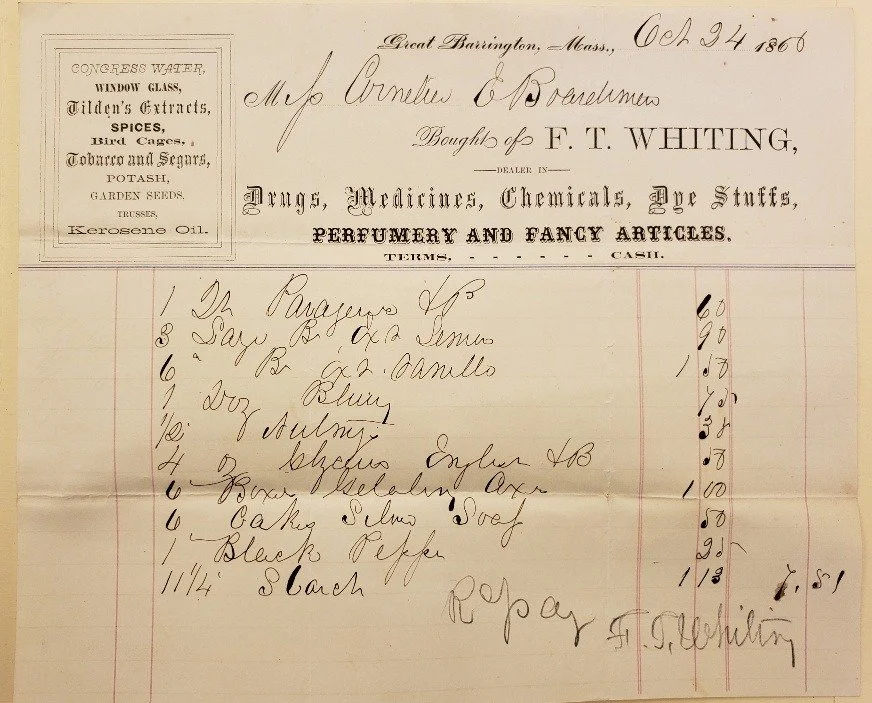
Long before automobiles, electricity, and even the Civil War, a woman named Cornelia E. Boardman visited a Whiting store and made ordinary purchases.
Today, that small handwritten receipt survives as a reminder that history is often preserved in everyday moments.
Dated October 24, 1860, the receipt predates the Whiting Block by more than three decades. Abraham Lincoln had not yet been elected president, and the nation stood on the brink of civil war.
Yet life in Great Barrington continued. Neighbors shopped, families gathered, and businesses like Whiting's served the needs of the community.
Sometimes the most extraordinary artifacts are the most ordinary.
A simple receipt connects us to a customer who walked through these doors more than 165 years ago.
CHAPTER FOUR
Before the Brick Building
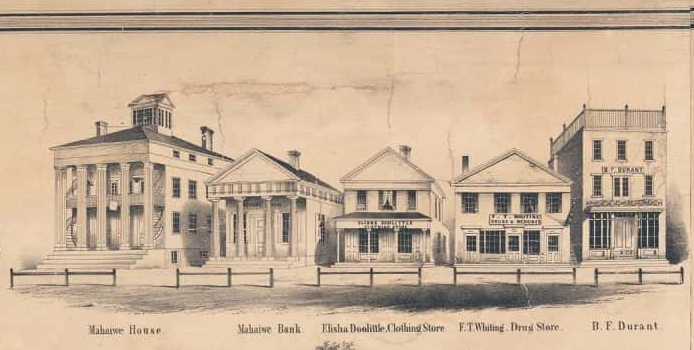
Long before the Whiting Block stood on Main Street, F. T. Whiting operated from an earlier storefront nearby.
This rare nineteenth-century engraving shows the original F. T. Whiting Drug Store among Great Barrington's prominent businesses.
By the 1880s, F. T. Whiting & Son had become one of the town's most trusted apothecaries, supplying medicines, patent remedies, spices, soaps, perfumes, and household goods.
Everything changed in 1894 when fire destroyed the original store. From those ashes rose the three-story brick building that still stands at 307 Main Street today.
The Whiting Block was not the beginning of the story. It was the next chapter.
CHAPTER FIVE
Fire and Rebirth
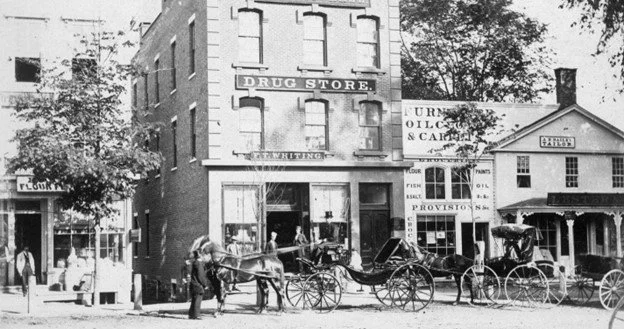
In 1894, fire destroyed the original F. T. Whiting Drug Store.
From those ashes rose the brick Whiting Block that still stands today.
Rebuilt in brick, the new building became known as the Whiting Block.
F. T. Whiting & Son returned to the ground floor, continuing a tradition of service that had already spanned decades.
Above the store, Masonic Hall occupied the upper floors, making the building a center of both commerce and community.
Built to endure, the Whiting Block reflected a growing and prosperous Great Barrington.
More than 130 years later, the Whiting Block remains one of Great Barrington's enduring landmarks.
CHAPTER SIX
The Day Main Street Lit Up
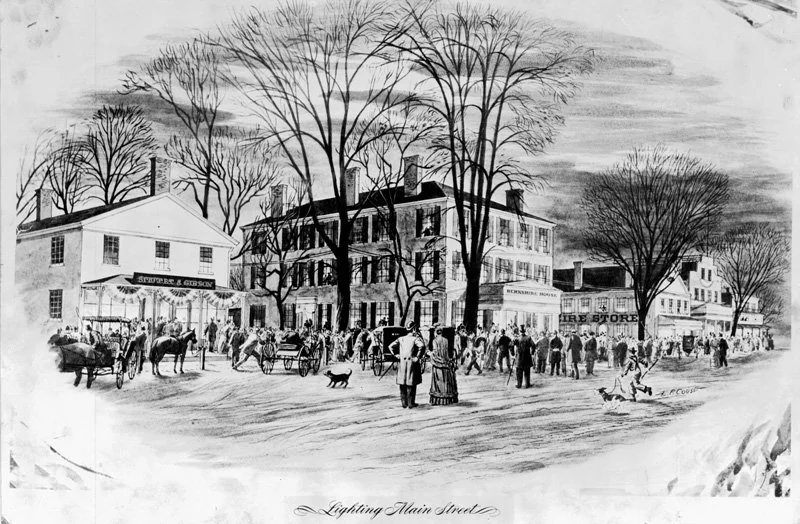
On March 20, 1886, practical alternating current electricity was first demonstrated in Great Barrington.
The modern electrical age began just steps from the Whiting Block.
In 1886, Great Barrington became the birthplace of practical alternating current electricity.
William Stanley Jr.'s successful demonstration would transform how the world was powered.
Working with George Westinghouse, Stanley used transformers to safely transmit electricity along Main Street.
On March 20, 1886, thirteen stores, two hotels, doctors' offices, the post office, and the telephone office were illuminated by this revolutionary system.
The demonstration proved that electricity could be transmitted efficiently over long distances, laying the foundation for the modern electrical grid.
THE FUTURE ARRIVED ON MAIN STREET.
CHAPTER SEVEN
Voices Across the Wires
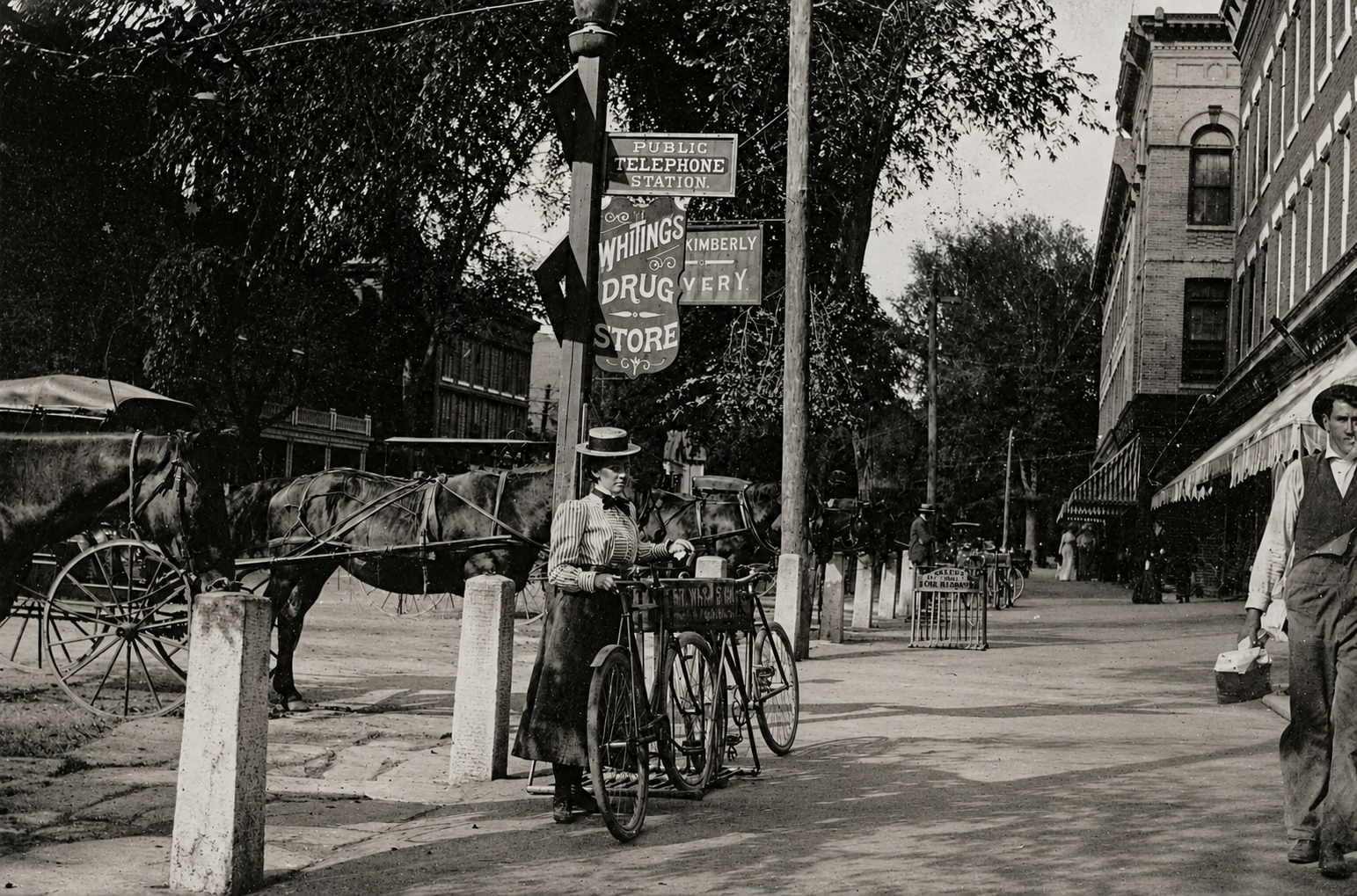
As electricity transformed Main Street, another revolution followed: communication.
Telephones brought neighbors, businesses, and families closer together, and F. T. Whiting & Son became one of the places where those connections could be made.
By the early twentieth century, the telephone had become an essential part of everyday life.
Photographs from the era show a telephone sign beside the Whiting store, and local records indicate that customers could access a public telephone there.
Like the apothecary itself, the store served not only as a place to purchase medicines and household goods, but also as a gathering place where information, news, and conversations were exchanged.
As technology evolved, the Whiting Block remained woven into the daily life of Great Barrington.
From remedies to conversations, the Whiting Block helped keep a community connected.
CHAPTER EIGHT
A New Chapter
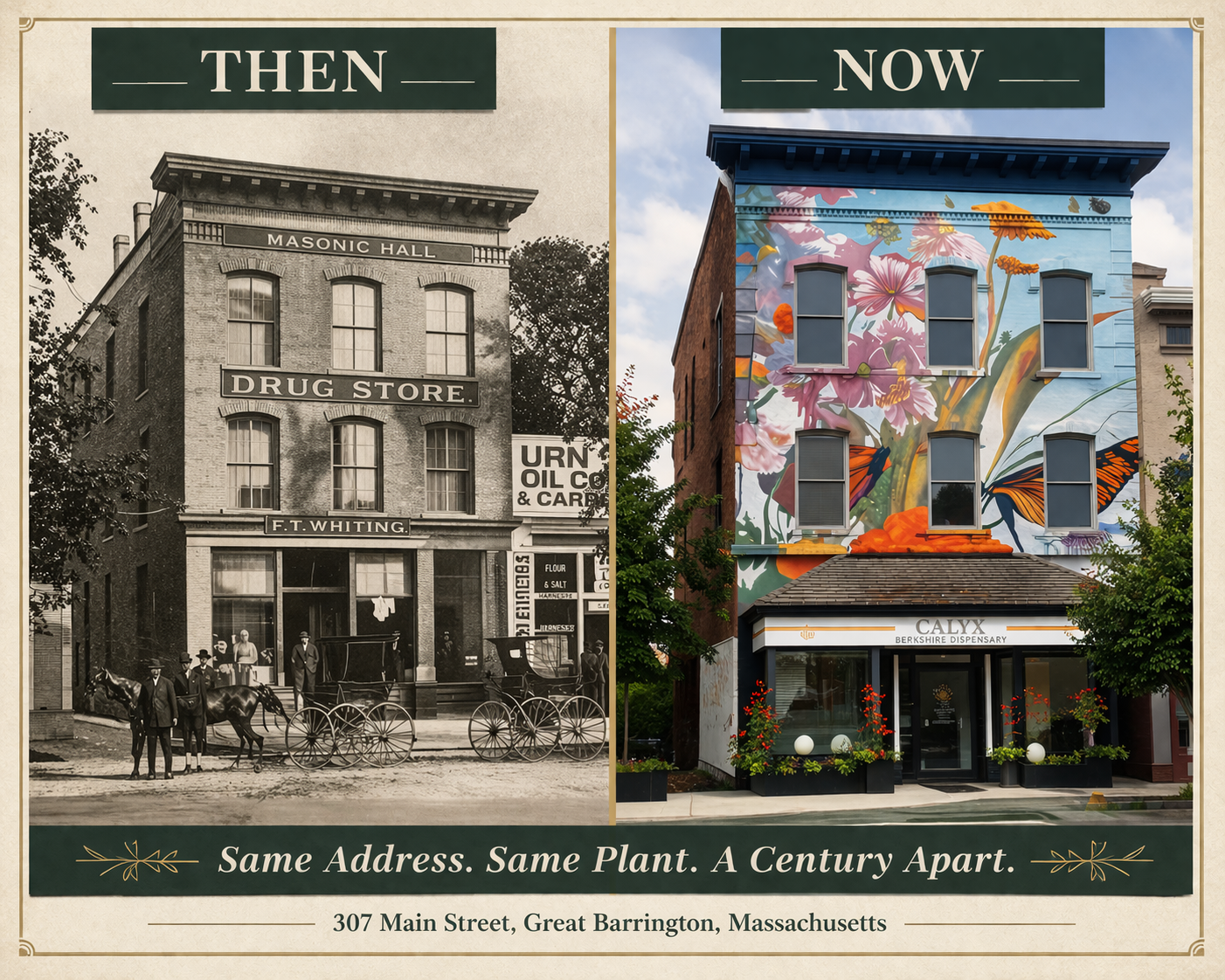
More than 130 years after it was built, the Whiting Block continues to serve the community.
Today, Calyx Berkshire carries forward a tradition of healing, curiosity, and connection.
Today, two murals add new chapters to the story. One celebrates the beauty and botanical heritage of the Berkshires. Around the corner, Terp Alley invites visitors to discover hidden botanical illustrations and the aromas found throughout nature.
Generations before us left their stories here.
Now, we have the privilege of adding our own.
Thank you for visiting the Whiting Block.
And thank you for helping keep its story alive.
The story of 307 Main Street is still being written.
Before you go, don't forget to visit Terp Alley and read the garden.